2 Sixth Street, Linden, Johannesburg
International Conference on e-Learning (ICEL), July 2018
Abstract: We live in a technology-immersed world where people of all ages, including students, high school children and many younger children and even toddlers, already have their own tablets, laptops as well as smart phones. Many people are convinced that the use of digital technologies, as in e-learning or blended learning is the best way to learn at school, varsity, home and at work. However, the reality is that many decision-makers are ill-informed on neuroscience and therefore the real advantages, as well as the disadvantages when using these technologies for learning from an early age. In many cases, much more time is needed for decision-makers, parents and educators to explore in-depth research articles on learning- and development topics before being lured into embracing these mesmerising technologies, under the umbrella of being educational. It is essential to have more in-depth knowledge around “good learning”, with and without digital technologies. Only when we are empowered with knowledge and critical insights on these learning topics, including neuroscience and the impact of the misuse of technology and social media on the holistic development of all people, will we be able to make smarter and wiser decisions towards a brighter future and wellness for our children and humanity overall. Technology addiction and its associated negative impact on human minds, bodies and souls, are already well researched and will be referenced. Report will be given on a research project where learners were asked to complete a Self-assessment questionnaire, focusing on Multitasking. Based on research results and when applying critical and creative thinking, will we be able to find the ideal nexus for our learners’ holistic development, learning performance and future! We must be pro-active and more critical in today’s techno-immersed world to ensure we are embedding the ideal nexus with the relevant knowledge, strategies and 21st Century skills, and ready for the Fourth Industrial Revolution. A brief overview of an integrated holistic ecosystem to “Master Techno-life Balance™” and wellness as a solution to our real-world challenges in a techno-saturated world will be given.
Key Words: Neuroscience; blended learning; technology addiction; holistic; techno-life wellness.
1. Introduction
We live in a technology-immersed world. Many people of all ages, including students, high school children, primary and vulnerable younger children and in some cases even toddlers, already have their own tablets, laptops as well as smart phones. Many of them nowadays use these to access the Internet and social media on a daily and continuous basis whenever and wherever they are. Too many people all over the world, as well as in South Africa, including parents and educators, are convinced the use of digital or educational technologies is essential and one of the best ways to learn at school, varsity, and college as well as at work.
However, the reality is that in many cases, educators and parents of today are ill-informed on neuroscience and therefore they are not critical enough to distinguish between the real advantages, disadvantages and negative impact on the holistic well-being of children of all ages when using these technologies for learning and social interaction. In many cases, parents and educators either have no time to get the most recent facts and figures or are not interested in more details and therefore believe the decision-makers would or should know the best for their children. However, parents should realise that they are co-responsible for their children’s development, learning, and wellness.
Most marketers in the field of learning technologies are not educational experts, and therefore only focusing on popular and positive learning outcomes without providing the other side of the coin. In general, much more time is needed for educators, parents and decision-makers to explore and retrieve in-depth research articles from all over the world, on related topics before being lured into embracing these mesmerising technologies, under the umbrella of being educational. Unfortunately, in most instances, they are not taking into account the overstimulation and addictive nature of these video (including educational) games.
In many cases, decision-makers, educators and parents are prone to either slavishly follow or be bullied into ill-considered projects around the implementation of e.g. mobile learning (with tablets) at their learning institutions. Therefore, it is essential to gain more in-depth knowledge around “good learning”, including best teaching and learning practices, with and without digital technologies. Only when we are empowered with more knowledge on these and other related topics, including neuroscience and Technology addiction, will we be able to start thinking about the holistic impact on humanity. We’ll then be able to focus on how to effectively manage the use of technologies and social media to prevent negative medium and long-term impact on the wellness of our families and children.
Technology addiction and its associated negative impact on human minds, bodies and souls, are already well-researched and therefore we must implement only sound and effective blended learning practices. We need to open our eyes, ears and minds to these realities and thereby become more critical and creative thinkers about applications. Then only, will we be better informed to make the right choices and decisions for our children’s learning, development, wellness and future!
We must realise the importance of being pro-active in this regard. Therefore, it is essential to be empowered by neuroscientific knowledge, strategies and skills, founded in the “Integrated Techno-life Balance System™” to master TechnoLife Wellness™.
2. Framework
2.1 Ecological perspective in Education
According to Ellis and Goodyear (2010:18-19), ecology entails studying the science of interactions between individual organisms and their environments. The environment is usually defined to mean both with other individuals of the same species, or of different species, and non-living elements such as the availability of food, water, shelter and sunlight. Ecological thinking also emphasises relationships and interdependencies between living and non-living things that forms a system. It is clear and acknowledged that in such a system change in one part of the system can have unforeseen consequences in another part of the system, or in the whole system. Ecological thinking and research are not only restricted to natural environments, but over the years, have also been used in human ecology and more specifically in research in higher education where the term “learning environment” is available and where students and other role players having a relation and impact on each other as well as the environment within which they are situated.
Although all learning environments (contexts) are different, these ecologies have one shared focus and function, namely to ensure that learning of students take place and therefore their learning processes must be supported in different ways. Gale (2002:66) refers to ecology as an approach which is “mindful of individuals, but also of learning environments that frame both institutional practices and individual experiences”.
Hannafin & Hannafin (1996: 52-53) also refers to an ecosystem as a metaphor to describe the complexities and interdependencies of the many elements and activities that contribute to the success in a learning environment. In learning environments, students as well as facilitators observe, measure, test, listen and reflect to assess the integrity and effectiveness of a learning environment. Accordingly, they will make changes along the way when and where needed. These changes may entail adjusting strategies, technologies and learning activities to achieve balance and the intended outcomes. It requires active and focused learning activities to develop understandings of how each element is working and how well all elements are functioning in the overall system to achieve the goals. Ecosystems are seen as successful when they promote equilibrium among their components and support their interactions and functions. The initial achievement of balance is critical for the ecosystem to evolve and must be maintained to survive and thrive.
2.2 Good learning characteristics and use of technology
Learning can be described as the cognitive process of a person acquiring a skill or knowledge whereby a change in performance can be measured or demonstrated, independent of a specific context, including place and time. Independent of context and available tools, Ellis & Goodyear (2010:25-26) focus on the following characteristics for good learning to take place:
- Learning is active: Implies that a range of cognitive processes must be completed on new information, to make it personally meaningful, i.e. to ensure that the individual student understands the information so that it can become part of their knowledge framework and change their thinking, behaviour and performance (including cognitive, social and emotional development). However, the type of cognitive processing that a student is using will determine how effective learning is taking place, e.g. deep processing versus shallow processing with limited understanding and long-term effect.
- Learning is cumulative: The existing knowledge framework of a learner will, to a large extent, determine how much sense they can make of new information. The prior knowledge of an individual learner related to the specific topic that’s activated during the learning process will have a significant impact on the efficacy of the learning event.
- Learning is individual: Every student constructs their own knowledge in a unique way, based on their own previous experiences while building it into existing knowledge frameworks, making sense of new information.
- Learning is self-regulated: Learners should be aware of their own learning activities and be able to take action based on this awareness. When a person stands back from their current learning task and reflect on how they are doing, they are engaged in metacognition. Metacognitive skills include reflection and self-regulation and contribute towards effective learning while changing approaches to problem-solving when necessary.
- Learning is goal-oriented: Goals need to be clear and understood by the learner to ensure effectiveness of learning. These goals can be set by the lecturer or student or can be negotiated, as long as they are explicit and prominent during learning. The formulation of smart goals is essential.
- Learning is situated: The learning processes and outcomes are significantly shaped and influenced by the physical and social context in which cognition and learning are taking place. Cognition and learning can be distributed across individuals and artefacts, and therefore it’s clear that what an individual can do on his or her own may be quite different from working with other people, tools and or other physical or digital resources.
This reality impacts on learning with technologies in three different ways:
- Realising that learning is socially situated in various forms of collaborative and cooperative learning;
- Help understanding interactions between individuals, groups of learners and technological artefacts, i.e. learning as being physically or digitally situated and
- Learning can also be understood and seen as an introduction into a community of practice whereby the appropriate use of cultural tools and practices increase recognition and status in a community.
In educational design, there’s a growing focus on the importance and recognition of the authenticity of learning tasks and learning contexts as well as the affordances of new technological resources.
- Learning is the experience of the student: Although this seems obvious, it is critical to again highlight that learning of the student must stay central to all innovations in learning and subsequent learning experiences, especially with the introduction of new technologies where the educator’s or researcher’s focus can easily be diverted towards the technology (as tool) instead of focusing on the development of students’ understanding and their experiences to facilitate their learning.
We need to further explore the characteristics of good lecturers to support great learning outcomes, before we critically look at the challenges and project results around the addictive nature of the use of technology and social media (e.g. multitasking versus focus on real-time learning opportunities). Only then should we be able to find the ideal nexus in a specific learning ecology.
2.3 Different generations’ perceptions around excellent teaching of good lecturers
According to Hartman, Moskal and Dziuban from the University of Central Florida in Oblinger & Oblinger (2005: 6.12), after collecting data from more than half a million students at their university, there are six characteristics of excellent lecturers that are independent of age, gender and academic achievement. The characteristics of good lecturers are grounded in what they all do:
- Facilitate student learning
- Communicate ideas and information effectively
- Demonstrate genuine interest in student learning
- Organise courses effectively
- Show respect and concern for students
- Assess student progress fair and effectively.
Although students’ behaviours, attitudes and expectations may be shaped by their generation, it appears that what constitutes good teaching is universal across different generations.
After a survey focusing on assessing generations in online learning, the authors also came to the conclusion that blended learning approaches provides a unique opportunity to bridge expectations between different generations and preferences of different student populations (2005,6.10).
2.4 Neuroscience and education
According to Zadina (2015:71), it has been almost twenty years since the first attempts to make inferences from neuroscience to classroom practice. Zadina referred to Bruer who had the opinion that it’s a “bridge too far”, because educators are lacking scientific understanding and making untenable leaps. However, in the refernced article of 2015, Zadina is convinced it’s now the right time to ensure those different perspectives that are coming from neuroscience and educational practice should be integrated towards reforming and informing education. It seems that as Educational Neuroscience gradually will be recognised as an authentic field, training will improve, and more information will flow both ways to inform research and practice. Zadina (and the author of this paper) argue that Educational Neuroscientists who can blend neuroscience, education and psychology should inform and make curriculum choices and not politicians or people who have money interests in e.g. new technology innovations.
As in many other professional careers, the author is convinced that educators must also stay up to date with new learning about the brain, body and other related physiological insights coming from neuroscientific research. These new insights must be presented to educators during continuous professional development workshops to enhance understanding of our students and thereby support the design of meaningful and authentic learning activities. This will ensure effective learning ecologies and achievement of goal-oriented learning outcomes and should align with employer expectations.
In another article stresses Martin-Loeches (2015:69) the fact that Leisman, Mualem and Mughrabi (2015:79-96) has pointed out that brain-imaging techniques confirmed that brain maturation extends over the first two decades of life and not only the first three years of life, as previously believed. This fact is very important since this phase of adolescent development traditionally has received less attention than the other earlier phases for pedagogical and educational development purposes. Also, these maturation processes concern critical brain regions that are important for social cognition and self-consciousness as well as problem-solving and abstract thinking.
By taking these new confirmed facts about neuroscience and brain maturation into account when exploring the wise use of educational technology and mobile learning in learning ecologies, we need to be very critical and cautious of what, when and how we are introducing and embracing these learning technologies to find the ideal nexus. We need to acknowledge the fragility of developing brains of our children from baby to toddler, young child to adolescent and young adult and thereby carefully (re)consider the impact of the misuse of technology on a daily and regular basis.
2.5 Neuroscience and internet addiction
The following quotation is taken from the abstract of the article by Cash et al (2012:292): “Problematic computer use is a growing social issue which is being debated worldwide. Internet Addiction Disorder (IAD) ruins lives by causing neurological complications, psychological disturbances, and social problems.”
Also, The American Society of Addiction Medicine has in 2012, for the first time released a new definition for addiction, stating it as a chronic brain disorder and is not linked only to substance abuse. All addictions, whether chemical or behavioural, have certain characteristics in common: being salience, having mood modifications and alleviation of distress, compulsive use (loss of control), tolerance and withdrawal and the continuation despite negative consequences.
There are different Internet Addiction assessment tools that are available and can be used as is or slightly customised in evaluations. However, Cash et al (2012:294) pointed out that Beard recommends that the following five diagnostic criteria are present for a diagnosis of Internet addiction:
- Is preoccupied with the Internet;
- Needs to use the Internet with increased amounts of time to achieve satisfaction;
- Has made unsuccessful efforts to control, cut back, or stop Internet use;
- Is restless, moody, depressed, or irritable when attempting to cut down or stop Internet use;
- Has stayed online longer than originally intended.
- Additionally, at least one of the following must be present:
- Has jeopardized or risked the loss of a good relationship, job, educational or career opportunity because of the Internet;
- Has lied to family members, therapist, or others to conceal the extent of involvement with the Internet;
- Uses the Internet as a way of escaping from problems or of relieving a dysphoric mood (e.g., feelings of helplessness, guilt, anxiety, depression).
According to Hart (2007:25), addictions develop when the pleasure system in our brains is hijacked by taking the pleasure circuits captive to such an extent that nothing else can get messages to the pleasure system, except the addicting substance or behaviour. He states very clearly that the overstimulation of our pleasure system, as now being experienced through many high-tech gadgets such as powerful computers with access to the Internet and multiplayer gaming, gambling, pornography, smart phones, and social media creates an addiction process. During this addiction process, the brain’s pleasure system (link to secretion of dopamine) is slowly shut down like a regular addiction and is referred to Anhedonia. According to Hart this “Overstimulation of the brain’s pleasure centre [has] the potential to do as much damage as addiction to any major drug”.
3. Method
3.1 Questionnaire
The core criteria elements of an Internet Addiction assessment tool were highlighted by Beard as referenced in the article on Internet Addiction by Cash et al (2012:292 -298). A Test for Multitasking Addiction is included in the book of Hart and Frejd (2013:83), of which the core elements of the criteria for the Internet Addiction test are related to the elements covered in the statements of the Multitasking Addiction Test. The researcher made small adjustments to customise the survey for the South African specific context where it was implemented. The questionnaire comprises ten statements on which participants had to indicate their involvement in or their view of the statement on a 5-point Likert scale.
3.2 Participants and procedure
The participants were located at a private high school in the Johannesburg area in South Africa. They comprised a group of Gr 11-learners who were present at a seminar on the current challenges of the technology tsunami and associated impact on the cognitive, social, physical and spiritual development of humans and their holistic wellness. The seminar was presented during the first class period on a weekday within a tight time frame. It was expected of the learners to complete the questionnaire during this period, before leaving the venue to go to their next class. Because of time constraints, only fifty completed questionnaires were received out of a group of 200 learners, i.e. 25 % responses were received.
4. Results
At the beginning of the survey, Multitasking was explained as being engaged with technology (including social media) and its associated applications and at the same time with other tasks such as homework and talking to someone. This means being busy in multiple activities or sources of stimulation at the same time, e.g. WhatsApp, YouTube, Internet surfing, gaming, TV watching, etc. (Hart& Frejd, 2013: 83).
The data received from the completed questionnaires were captured on a data sheet from where specific analyses were made. They were diagrammatically depicted and included in this paper for clarification.
Participants completed the questionnaires by indicating their responses on the ten statements (examples are referenced in the descriptions of Figure 2) in by filling in a number that responds with their level of involvement and time spent on a specific activity on the 5-point Likert scale. The total score of each participant’s assessment is depicted in Figure 1.
4.1 Interpretations of the scores:
Descriptions of Figure 1: The interpretations of these scores are aligned with Hart and Frejd (2013:83), although the researcher has adjusted the third and fourth parameters to make provision for the 5-point scale which was implemented. The percentages of these adjusted parameters correspond with the ones in their book.
- The majority of the learners, namely 60%, have a total score of 10 or less. It can be interpreted as being able to exercise appropriate control around multitasking and their use of technology.
- Another 24% have total scores between 11 and 14, and another 8% score between 15 and 19, which can be interpreted as occasional dependence on multitasking and may be signs of a growing addiction to technology.
- There are 4% of the respondents in the third group that indicates that the use of multitasking is excessive, addiction will become evident, and the problem needs to be addressed with some degree of urgency.
- The last 4%, i.e. 2 respondents out of the group of 50 questionnaires received, are addicted to multitasking (and the use of technology) and need professional help.
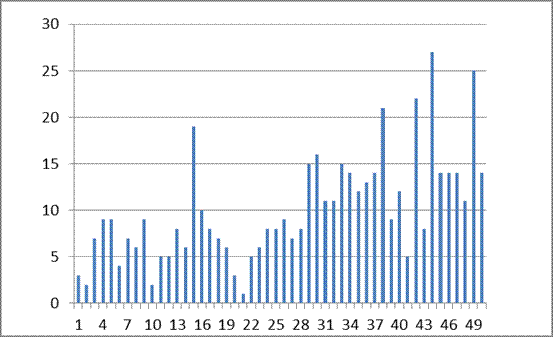
Figure 1: Total scores of individual participants
Descriptions of Figure 2: Items 1-10 run clockwise from 12:00 – as on a normal analogue watch.
- Item 1: Not willing to do extra household chores, because of engagement with technology and social media – 9%
- Item 2: Prefers the excitement of being stimulated by multiple tasks more than going outside or socialise with friends – 7%
- Item 3: Regularly negotiate with parent to complete game on computer before joining a family activity or dining together – 7%
- Item 4: Interactions with friends are mainly via Internet or social media – 13%
- Item 5: Time being spent on multitasking, technology and social media has a negative impact on your school or sport performance – 14%
- Item 6: Time being spent on multitasking, technology and social media has a negative impact on your relationships with family and friends – 8%
- Item 7: Losing sleep because of too much time being spent on multitasking, technology and social media – 12%
- Item 8: Feeling depressed or moody, but cheers up when involved with multitasking, technology and social media – 7%
- Item 9: Becomes moody or angry when there’s a problem with internet connection or technology which prevent multitasking – 18%
- Item 10: Feeling it’s difficult to really enjoy normal, simple tasks if it does not involve multitasking – 5%
The highest score that each participant could give an item is 4 marks. This means that the total score of each item is calculated out of 200 (50 respondents). The highest total scores show that these areas are more problematic when looking at the level of impact that multitasking already have on other areas of the learners’ social and cognitive contexts, namely:
- Item 4: 66 or 33%
- Item 5: 70 or 35%
- Item 7: 61 or 30,5%
- Item 9: Highest score of 91 or 45%.
These scores also correlate with the relative weighting or importance of these items in the item analysis, as highlighted in Italics.
Figure 2 gives an overview of the individual items and their relevant total scoring and percentages within the total survey.
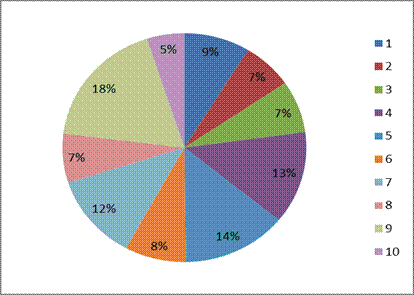
Figure 2: Distribution and relevance of responses
Figure 3 relates to the last question of the questionnaire. The learners were asked to indicate the average amount of hours they spend daily with technology, e.g. their smartphone, tablet, laptop or watching television. There were a few learners who didn’t complete this question. The researcher allocates “0” hours for these learners and therefore the correlation is not 100%. That action also explains the zero’s on the graph, although some of these learners actually had quite high total scores on their questionnaires.
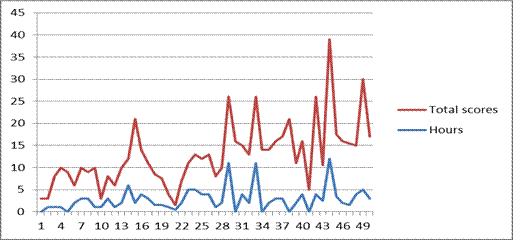
Figure 3: Correlation between total score and number of daily hours spend with technology
(Top graph represents Total scores and bottom graph represents Total hours)
5. Discussion
5.1 Multitasking
Drs Hart and Frejd (2013:74–90) spend a whole chapter in their book on confirming and clarifying the multitasking myth, especially around the fallacy of being able to complete higher order thinking tasks simultaneously. Many advocates of our modern digital world are calling all of us to become masters in multitasking, but this is definitely not recommended when we need to focus on novel cognitive and academic tasks.
We need to distinguish where this term originates from and realise that different people may have different understandings and that may contribute towards confusing the phenomenon. The fact is that our brains can’t complete two higher order cognitive tasks simultaneously without risks and inefficiencies, e.g. banning of texting and talking on a cell phone while driving a car. The brain cannot fully focus when pushed to multitask. It will take longer to complete a task and the likelihood of making an error is much higher, because the brain needs to switch, restart and refocus when continuously switching between tasks.
Drs Hart and Frejd (2013:75-76) mention that several studies on multitasking have found that multitasking is significantly less productive than its alternative, sequential tasking. The Institute of Psychiatry at the University of London conducted a study in 2005. They found that workers who were interrupted by phone calls or emails, suffered from a fall in their IQ level of 10 points (working memory), twice as much as people smoking marijuana. They predicted that job multitasking may become one of the greatest threats to workplace productivity in the future.
They also have a concern that “infomania” and digital connectedness may invade schools if we do not manage how learners are learning with technology and social media on their fingertips. After the authors have explored several research articles around the notion that multitasking facilitates better learning, they concluded that this is one of the greatest myths surrounding the digital world. The author of this article fully supports this conclusion.
Studies at Harvard and Stanford Universities among their brightest students also confirmed this finding (Hart& Frejd, 2013:81), although ALL the students thought they were doing better. Their performances were reduced by one-third when multitasking. Peter Bregman’s blog which was published in the Harvard Business Review, also highlighted “How (and Why) to Stop Multitasking” (2010).
Nicholas Carr (2016) wrote in his book: “The Shallows: What the Internet is Doing to Our Brains” that the Internet is designed to be an interruption system, a machine geared to dividing attention and to addict.
Negative consequences of multitasking are not only confined to the workplace, but also has an impact on our ability to effectively learn and focus. It was already pointed out that our brains struggle sorting out which task to perform when confronted with many tasks simultaneously and thereby losing time and effectiveness. There is also an increase in stress hormones like adrenaline when multitasking which can have a long-term effect on our health and holistic wellness. An increase in stress also leads to a loss of short-term memory and could seriously affect our learning ability.
5.2 Ideal nexus: Technolife balance and wellness
Reflecting on the information and knowledge shared in this paper, we must acknowledge the critical importance of being pro-active and empowered with the necessary knowledge, strategies and skills to master “The Art of Techno-life Balance” in our techno-mad world. The researcher has designed and developed an “Integrated Techno-life Balance System™”, which contains several empowerment tools which she is implementing as a neuro synergetic framework. Several TechnoLife SMART™ Programmes which are grounded in this framework are offered when engaging with learners who need knowledge and skills to flourish in our techno-immersed world, at home, at school/ varsity, and at work. Sharpening our creative minds and bodies through implementing different neuro-synergetic strategies and skills, are the focal points in this framework. The overall goal is to find the ideal nexus while learning with technologies in different ecosystems. At the same time, we must ensure the mastering of techno-life balance and wellness. We need to nurture TechnoLife Wellness™ ambassadors who are resilient; embrace technological changes and transformation when and where needed while optimising their holistic human potential to enhance their performance.
References
Bregman, P. (2010) How (and Why) to Stop Multitasking. Harvard Business Review, May 20, 2010. Available at: http://blogs.hbr/bregman/2010/05/how-and-how-to-stop-multitasking.html.
Carr,N. (2016) The Shallows: What the Internet is Doing to Our Brains. In Eyal, N. Who’s really addicting you to technology? [online], http://www.nirandfar.com/2016/02/4-people-addicting-technology.html?utm.source.
Cash, H., Rae, C. H. Steel, A.H. and Winkler, A. (2012) “Internet Addiction: A Brief Summary of Research and Practice”. Current Psychiatry Reviews, Vol.8, pp 292-298.
Domintheil, I. (2015) Development of the Social Brain in Adolescence. Psicologicia Educativa, Vol 21, pp 117-124.
Ellis, R. A., and Goodyear, P. (2010) Students’ Experiences of E-Learning in Higher Education. Routledge, New York.
Gale, T. (2002) Degrees of difficulty: An Ecological Account of Learning in Australian Higher Education. Studies in Higher Education, Vol. 27, pp 65-68.
Hannafin, K. and Hannafin, M. (1996) The Ecology of Distance Learning Environments. Training Research Journal, Vol. 1, pp 47-70.
Hartman, J., Moskal, P. and Dzuiban, C. Preparing the Academy Today for the Learner of Tomorrow. In Oblinger, D. G. and Oblinger, J. L. (2005) Educating the Net Generation (pp 6.1-6.15). Educause.
Hart, A. (2007) Thrilled to Death: How the Endless Pursuit of Pleasure is Leaving us Numb. Thomas Nelson, Nashville.
Hart, A. and Hart Frejd, S. (2013) The Digital Invasion: How Technology is Shaping You and Your Relationships. Baker Books, Michigan.
Leisman, G., Mualem, R and Mughrabi, S. K. (2015) The Neurological Development of the Child with Educational Enrichment in Mind. Psicologicia Educativa, Vol. 21, pp 79-96.
Martin-Loeches, M. (2015) Neuroscience and Education: We Already Reached the Tipping Point. Psicologicia Educativa, Vol. 21, pp 67-70.
Oblinger, D. G. and Oblinger, J. L. (2005) Educating the Net Generation. Educause.
Zadina, J. N. (2015) The Emerging Role of Educational Neuroscience in Education Reform. Psicologicia Educativa, Vol. 21, pp 71-77.